Materials: Engineering, Science, Processing and Design

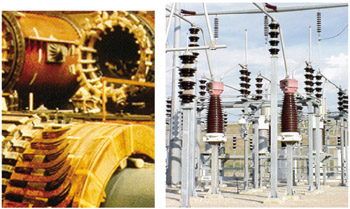
Conductors and insulators. Copper, aluminum and silver (if you can afford it) make good conductors. Pyrex, porcelain and ceramics like alumina make good insulators - they are dielectrics. (Images courtesy of the Copper Development Association.)
York Minster, constructed between 1220 and 1400, is one of the great cathedrals of Europe. Many fine sermons have been preached from its pulpit, but when, in 1984, the Archbishop of York expressed his disbelief in the Virgin Birth, the Minster was struck by lightning and severely damaged. Some put this down to the wrath of God, but the reality is simpler: the cathedral was inadequately earthed. There is a message here: even when you are designing cathedrals, electrical properties matter.
This chapter is about the simplest of these: they relate to conduction, insulation and dielectric behavior. Electrical conduction (as in lightning conductors) and insulation (as in electric plug casings) are familiar properties. Dielectric behavior may be less so. A dielectric is an insulator. It is usual to use the word 'insulator' when referring to its inability to conduct electricity, and to use 'dielectric' when referring to its behavior in an electric field. Three properties are of importance here. The first, the dielectric constant (or relative permittivity), has to do with the way the material acquires a dipole moment (it polarizes) in an electric field. The second, the dielectric loss factor, measures the energy dissipated when radio-frequency waves pass through a material, the energy...