Materials: Engineering, Science, Processing and Design
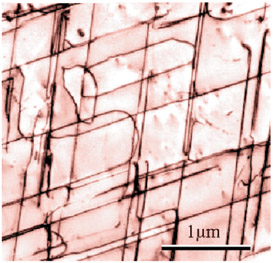
Dislocations in the intermetallic compound, Ni3Al. (Image courtesy of C. Rentenberger and H.P. Karnthaler, Institute of Materials Physics, University of Vienna, Austria.)
The verb 'to yield' has two, seemingly contradictory, meanings. To yield under force is to submit to it, to surrender. To yield a profit has a different, more comfortable, connotation: to bear fruit, to be useful. The yield strength, when speaking of a material, is the stress beyond which it becomes plastic. The term is well chosen: yield and the plasticity that follows can be profitable it allows metals to be shaped and it allows structures to tolerate impact and absorb energy. But the unplanned yield of the span of a bridge or of the wing-spar of an aircraft or of the forks of your bicycle spells disaster.
This chapter is about yield and plasticity. For that reason it is mainly (but not wholly) about metals: it is the plasticity of iron and steel that made them the structural materials on which the Industrial Revolution was built, enabling the engineering achievements of the likes of Telford [1] and Brunel [2]. The dominance of metals in engineering, even today, derives from their ability to be rolled, forged, drawn and stamped.
[1]Thomas Telford (1757 1834), Scottish engineer, brilliant proponent of the suspension bridge at a time when its safety was a matter of debate. Telford may himself have had doubts he was given to lengthy prayer on the days that the suspension chains were scheduled...