Materials: Engineering, Science, Processing and Design

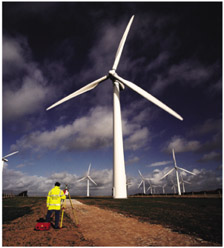
Power from the wind. (Image courtesy of Leica Geosystems, Switzerland.)
The practice of engineering consumes vast quantities of materials and is dependent on a continuous supply of them. We start by surveying this consumption, emphasizing the materials used in the greatest quantities. Increasing population and living standards cause this consumption rate to grow something it cannot do forever. Finding ways to use materials more efficiently is a prerequisite for a sustainable future.
There is a more immediate problem: present-day material usage already imposes stress on the environment in which we live. The environment has some capacity to cope with this, so that a certain level of impact can be absorbed without lasting damage. But it is clear that current human activities exceed this threshold with increasing frequency, diminishing the quality of the world in which we now live and threatening the well-being of future generations. Design for the environment is generally interpreted as the effort to adjust our present product design efforts to correct known, measurable, environmental degradation; the time-scale of this thinking is 10 years or so, an average product's expected life. Design for sustainability is the longer-term view: that of adaptation to a lifestyle that meets present needs without compromising the needs of future generations. The time-scale here is less clear it is measured in decades or centuries and the adaptation required is much greater.
Speaking globally, we consume roughly 10 billion (10 10) tonnes of...