Materials: Engineering, Science, Processing and Design

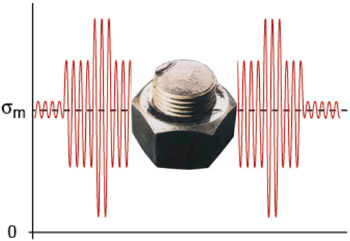
A bolt that has failed by fatigue. The fatigue crack initiated at the root of a thread, which acts as a notch, concentrating stress. (Image courtesy Bolt Science (www.Boltscience.com))
German engineering was not always what it is today. The rapidly expanding railway system of the mid-19th century was plagued, in Germany and elsewhere, by accidents, many catastrophic, caused by the failure of the axles of the coaches. The engineer August W hler [1] was drafted in to do something about it. It was his systematic tests that first established the characteristics of what we now call fatigue.
Repetition is tiring, the cause of many human mistakes and accidents. Materials, too, grow tired if repeatedly stressed, with failure as a consequence. This chapter is about the energy that is dissipated, and the damage and failure that can result, when materials are loaded in a cyclic, repetitive way. Even when the amplitude of the cycles is very small, some energy dissipation or damping occurs. Larger amplitudes cause the slow accumulation of damage, a little on each cycle, until a critical level is reached at which a crack forms. Continued cycling causes the crack to grow until the component suddenly fails. Fatigue failure is insidious there is little sign that anything is happening until, bang, it does. So when the clip breaks off your pen or your office chair collapses, it is probably fatigue that is responsible (cover picture).
We start with cyclic loading at very small amplitudes and...