Materials: Engineering, Science, Processing and Design

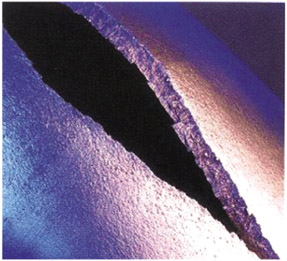
Fractured pipe (Image courtesy Prof. Robert Akid, School of Engineering, Sheffield Hallam University, Sheffield UK).
It is very hard to build a structure that is completely without cracks. As explained in Chapter 8, cracks caused by shrinkage in casting and welding, by the cracking of inclusions during rolling, or just caused by careless machining are commonplace. And even if there are no cracks to start with, cyclic loading (Chapter 9) and corrosion (Chapter 17) can introduce them later.
This creates the need for design methods to deal with cracked structures. The idea of the tensile stress intensity K 1 caused by a crack was introduced in Chapter 8. It depends on crack length, component geometry and the way the component is loaded. We start with standard solutions for the stress intensity K 1 associated with generic configurations there are others, but this is enough to get started. Cracks will not propagate if this K 1 is kept below the fracture toughness K 1c of the material of the structure.
This might suggest that the best material to resist fracture is the one with the highest K 1c and in load-limited design it is. But sometimes the requirement is not to carry a given load without failure, but to store a given energy (springs) or allow a given deflection (elastic couplings) without failure. Then the best choice of material involves combinations of K 1c and Young's modulus E, as we will see...