Materials: Engineering, Science, Processing and Design

The taxonomy of manufacturing processes was presented in Chapter 2. There, it was established that processes fall into three broad families: shaping, joining and finishing (Figures 2.4 and 2.5). Each is characterized by a set of attributes listed, in part, in Figures 2.6 and 2.7.
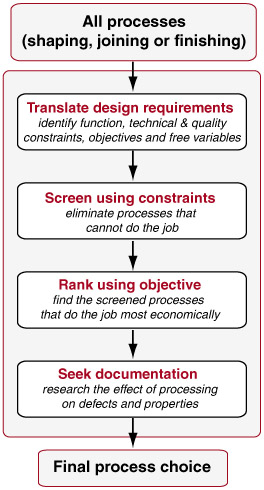
The strategy for materials selection was outlined in Chapter 3. The procedure, whether dealing with original design or refining an existing one, was to translate the design requirements into a set of constraints and objectives. The constraints are used to screen and the objectives to rank, delivering a preferred short-list of materials that best meet both, finally seeking documentation to guide the final choice. The strategy for selecting processes follows a parallel path, shown in Figure 18.1. It uses constraints on process attributes to screen, together with an appropriate objective to rank, culminating as before with a search for information documenting the details of the top-ranked candidates.
As we saw in earlier chapters, the function of a component dictates the initial choice of material and shape. This choice exerts constraints on the choice of processes. It is helpful to think of two types of constraint: technical can the process do the job at all? And quality can it do so sufficiently well? One technical constraint applies...