Video Demystified: A Handbook for the Digital Engineer, Fourth Edition

Chapter 11: Consumer DV

Overview

The DV (digital video) format is used by tape-based digital camcorders, and is based on IEC 61834 (25 Mbps bit rate) and the newer SMPTE 314M and 370M specifications (25, 50 or 100 Mbps bit rate). The compression algorithm used is neither motion-JPEG nor MPEG, although it shares much in common with MPEG I frames. A proprietary compression algorithm is used that can be edited since it is an intra-frame technique.

The digitized video is stored in memory before compression is done. The correlation between the two fields stored in the buffer is measured. If the correlation is low, indicating inter-field motion, the two fields are individually compressed. Normally, the entire frame is compressed. In either case, DCT-based compression is used.

To achieve a constant 25, 50 or 100 Mbps bit rate, DV uses adaptive quantization, which uses the appropriate DCT quantization table for each frame.

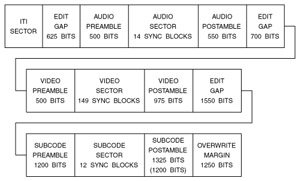
Figure 11.1 illustrates the contents of one track as written on tape. The ITI sector (insert and track information) contains information on track status and serves in place as a conventional control track during video editing.


Figure 11.1: Sector Arrangement for One Track for a 480i System. The total bits per track, excluding the overwrite margin, is 134,975 (134,850). There are 10 (12) of these tracks per video frame. 576i system parameters (if different) are shown in parentheses.

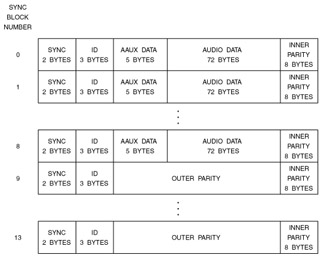
The audio sector, shown in Figure 11.2, contains both audio data and auxiliary audio data (AAUX).


Figure 11.2: Structure of Sync Blocks in...

UNLIMITED FREE
ACCESS
TO THE WORLD'S BEST IDEAS

SUBMIT
Already a GlobalSpec user? Log in.

This is embarrasing...

An error occurred while processing the form. Please try again in a few minutes.

Customize Your GlobalSpec Experience

Category: Video Cameras
Finish!
Privacy Policy

This is embarrasing...

An error occurred while processing the form. Please try again in a few minutes.