Video Demystified: A Handbook for the Digital Engineer, Fourth Edition

PES Packet

A packetized elementary stream (PES), consists of a single elementary stream (ES) which has been made into packets, each starting with an added packet header. A PES contains only one type of data (audio, video, etc.) from one source.

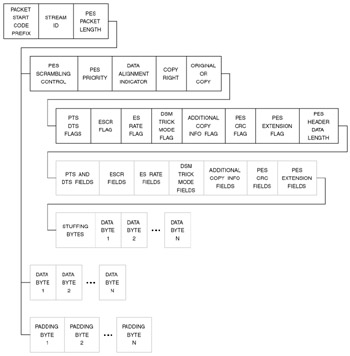
The general format of the PES packet is shown in Figure 13.21. Note that start codes (000001xx H) must be byte aligned by inserting 0 7 "0" bits before the start code.


Figure 13.21: MPEG-2 PES Packet Structure. Marker and reserved bits not shown.

Packet_start_code_prefix

This 24-bit field has a value of 000001 H and in conjunction with stream_ ID, indicates the beginning of a packet

Stream_ID

This 8-bit code specifies the type and number of elementary streams, as shown in Table 13.41. For the ATSC and OpenCable standards, the value for audio streams must be "10111101" to indicate Dolby Digital.

PES_packet_length

This 16-bit binary number specifies the number of bytes in the PES packet following this field. A value of zero indicates it is neither specified nor bounded, and is used only in transport streams. For the ATSC standard, the value must be 0000 H for video streams.

Note

The following fields (until the next note) are not present if stream_ID = program stream map, padding stream, private stream 2, ECM stream, EMM stream, DSM-CC stream, H.222.1 type E, or program stream directory.

Marker_bits

These optional two bits have a value of "10."

PES_scrambling_control

This optional 2-bit code specifies the scrambling mode.

UNLIMITED FREE
ACCESS
TO THE WORLD'S BEST IDEAS

SUBMIT
Already a GlobalSpec user? Log in.

This is embarrasing...

An error occurred while processing the form. Please try again in a few minutes.

Customize Your GlobalSpec Experience

Category: Parity Checkers and Generators
Finish!
Privacy Policy

This is embarrasing...

An error occurred while processing the form. Please try again in a few minutes.