Video Demystified: A Handbook for the Digital Engineer, Fourth Edition

Video Coding Layer

YCbCr Color Space

MPEG-2 uses the YCbCr color space, supporting 4:2:0, 4:2:2 and 4:4:4 sampling. The 4:2:2 and 4:4:4 sampling options increase the chroma resolution over 4:2:0, resulting in better picture quality.

The 4:2:0 sampling structure for MPEG-2 is shown in Figures 3.8 through 3.10. The 4:2:2 and 4:4:4 sampling structures are shown in Figures 3.2 and 3.3.

Coded Picture Types

There are three types of coded pictures. I (intra) pictures are fields or frames coded as a stand-alone still image. They allow random access points within the video stream. As such, I pictures should occur about two times a second. I pictures also should be used where scene cuts occur.

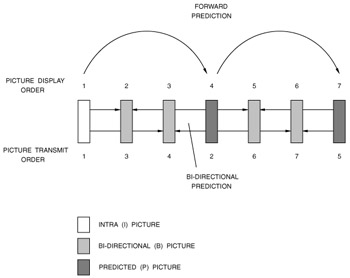
P (predicted) pictures are fields or frames coded relative to the nearest previous I or P picture, resulting in forward prediction processing, as shown in Figure 13.1. P pictures provide more compression than I pictures, through the use of motion compensation, and are also a reference for B pictures and future P pictures.


Figure 13.1: MPEG-2 I, P, and B Pictures. Some pictures can be transmitted out of sequence, complicating the interpolation process and requiring picture reordering by the MPEG decoder. Arrows show inter-frame dependencies.

B (bidirectional) pictures are fields or frames that use the closest past and future I or P picture as a reference, resulting in bidirectional prediction, as shown in Figure 13.1. B pictures provide the most compression. and decrease noise by averaging two pictures. Typically, there are two B pictures separating I...

UNLIMITED FREE
ACCESS
TO THE WORLD'S BEST IDEAS

SUBMIT
Already a GlobalSpec user? Log in.

This is embarrasing...

An error occurred while processing the form. Please try again in a few minutes.

Customize Your GlobalSpec Experience

Category: Video Cameras
Finish!
Privacy Policy

This is embarrasing...

An error occurred while processing the form. Please try again in a few minutes.