Video Demystified: A Handbook for the Digital Engineer, Fourth Edition

A color space is a mathematical representation of a set of colors. The three most popular color models are RGB (used in computer graphics); YIQ, YUV, or YCbCr (used in video systems); and CMYK (used in color printing). However, none of these color spaces are directly related to the intuitive notions of hue, saturation, and brightness. This resulted in the temporary pursuit of other models, such as HSI and HSV, to simplify programming, processing, and end-user manipulation.
All of the color spaces can be derived from the RGB information supplied by devices such as cameras and scanners.
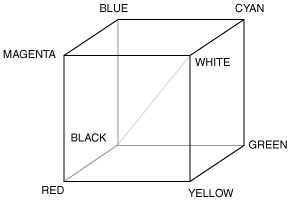
The red, green, and blue (RGB) color space is widely used throughout computer graphics. Red, green, and blue are three primary additive colors (individual components are added together to form a desired color) and are represented by a three-dimensional, Cartesian coordinate system (Figure 3.1). The indicated diagonal of the cube, with equal amounts of each primary component, represents various gray levels. Table 3.1 contains the RGB values for 100% amplitude, 100% saturated color bars, a common video test signal.
| Normal Range | White | Yellow | Cyan | Green | Magenta | Red | Blue | Black | |
|---|---|---|---|---|---|---|---|---|---|
| R | 0 to 255 | 255 | 255 | 0 | 0 | 255 | 255 | 0 | 0 |
| G | 0 to 255 | 255 | 255 | 255 | 255 | 0 | 0 | 0 | 0 |
| B | 0 to 255 | 255 | 0 | 255 | 0 | 255 | 0 | 255 | 0 |
The RGB color space is the most prevalent choice for computer...