Overview
Although not exactly "digital" video, the NTSC and PAL composite color video formats are currently the most common formats for video. Although the video signals themselves are analog, they can be encoded and decoded almost entirely digitally.
Analog NTSC and PAL encoders and decoders have been available for some time. However, they have been difficult to use, required adjustment, and offered limited video quality. Using digital techniques to implement NTSC and PAL encoding and decoding offers many advantages such as ease of use, minimum analog adjustments, and excellent video quality.
In addition to composite video, S-video is supported by consumer and pro-video equipment, and should also be implemented. S-video uses separate luminance (Y) and chrominance (C) analog video signals so higher quality may be maintained by eliminating the Y/C separation process.
This chapter discusses the design of a digital encoder (Figure 9.1) and decoder (Figure 9.21) that support composite and S-video (M) NTSC and (B, D, G, H, I, N C) PAL video signals. (M) and (N) PAL are easily accommodated with some slight modifications.
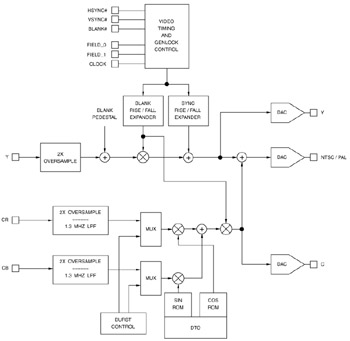 Figure 9.1: Typical NTSC/PAL Digital Encoder Implementation.
 NTSC encoders and decoders are usually based on the YCbCr, YUV, or YIQ color space. PAL encoders and decoders are usually based on the YCbCr or YUV color space.


 TABLE OF CONTENTS