Video Demystified: A Handbook for the Digital Engineer, Fourth Edition

Motion Compensation

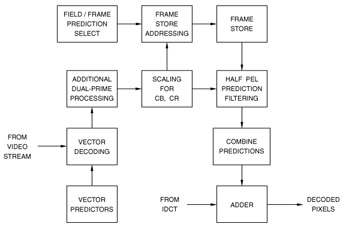
Figure 13.14 illustrates the basic motion compensation process. Motion compensation forms predictions from previously decoded pictures, which are in turn combined with the coefficient data (error terms) from the IDCT.


Figure 13.14: Simplified Motion Compensation Process.

Field Prediction

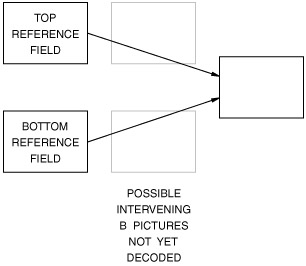
Prediction for P pictures is made from the two most recently decoded reference fields. The simplest case is shown in Figure 13.15, used when predicting the first picture of a frame or when using field prediction within a frame.


Figure 13.15: P Picture Prediction of First Field or Field Prediction in a Frame Picture.

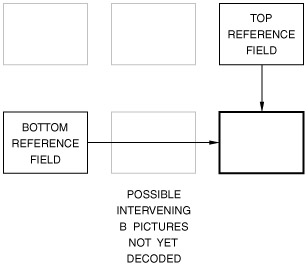
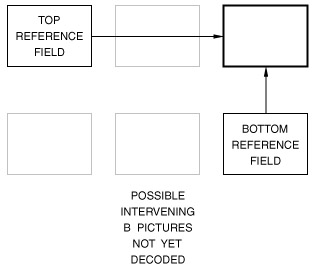
Predicting the second field of a frame also requires the two most recently decoded reference fields. This is shown in Figure 13.16 where the second picture is the bottom field and in Figure 13.17 where the second picture is the top field.


Figure 13.16: P Picture Prediction of Second Field Picture (Bottom Field).

Figure 13.17: P Picture Prediction of Second Field Picture (Top Field).

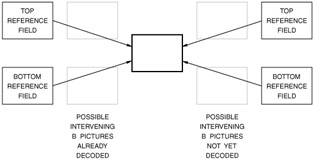
Field prediction for B pictures is made from the two fields of the two most recent reference frames, as shown in Figure 13.18.


Figure 13.18: Field Prediction of B Field or Frame Pictures.

Frame Prediction

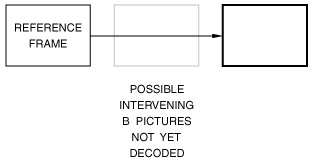
Prediction for P pictures is made from the most recently decoded picture, as shown in Figure 13.19. The reference picture may have been coded as either two fields or a single frame.


Figure 13.19: Frame Prediction For P Pictures.

Frame prediction for B pictures is made from the two most recent reference frames, as shown in Figure...

UNLIMITED FREE
ACCESS
TO THE WORLD'S BEST IDEAS

SUBMIT
Already a GlobalSpec user? Log in.

This is embarrasing...

An error occurred while processing the form. Please try again in a few minutes.

Customize Your GlobalSpec Experience

Category: Board Cameras
Finish!
Privacy Policy

This is embarrasing...

An error occurred while processing the form. Please try again in a few minutes.