Control Theory, Second Edition

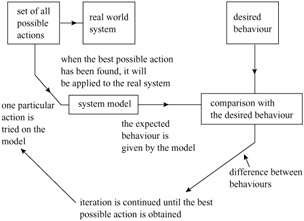
In the previous chapter we saw that prerequisites for control design were broadly: a defined objective, a set of available actions and a model that could be interrogated to establish which of the available actions would best move the system towards meeting the objective. Now we add more structure to the concepts to put forward a possible design methodology (Figure 2.1). In this methodology, central use is made of a system model. This model is assumed able to rapidly calculate the expected behaviour of the system when subjected to any particular action.
Questions that immediately arise are:
In practice can a realistic model be produced? If so how?
By what mechanism can two sorts of behaviour be compared?
Can the difference between desired behaviour and expected behaviour be meaningfully used to help the iteration towards the best possible choice of action?
How fast would the iterative procedure, involving the model, have to operate in order for the real world system to be realistically controlled?
We answer none of these questions directly, preferring to state that Figure 2.1 remains largely symbolic. Meanwhile we ask a further question.
If the system model and the desired behaviour are accurately defined should it not be possible, in one pass, to synthesise the necessary actions shown in Figure 2.1 without interactive searching?
This question is illustrated graphically in Figure 2.2.