Control Theory, Second Edition

Chapter 4: How the Laplace Transform Greatly Simplifies System Representation and Manipulation

4.1 Laplace transform techniques

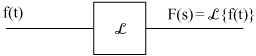
Many useful techniques depend on the Laplace transform. The Laplace transform of a function f( t) is denoted sometimes by L{f( t)} and sometimes by F( s). The inverse Laplace transform of F( s) is denoted sometimes by L -1{ F( s)} and sometimes by f( t). Figure 4.1 makes the relation clear; s is a complex variable whose role is defined by eqn. 4.1.


Figure 4.1: The Laplace transform operation

4.2 Definition of the Laplace transform

By definition

(4.1)
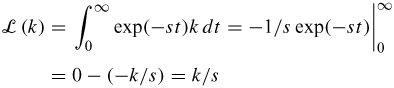
  1. Let f( t) = a constant k, and let R( s) denote the real part of the complex number s


provided that R( s) is positive (for otherwise the integral does not exist).

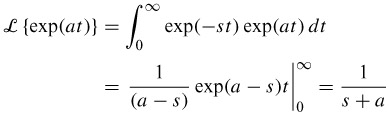
  1. Let f( t) = exp( at)


This will be true provided that R( s) > a.

The chore of calculating Laplace transforms of particular time functions and the converse problem - calculating the time function, by inverse Laplace transformation, corresponding with a particular Laplace transform - can be avoided by the use of software packages or tables of transform pairs. Small tables are to be found as appendices in many introductory control textbooks. A larger set of tables can be found in McCollum and Brown (1965) and a very comprehensive set in Prudnikov et al. (1992).

Example 4A: Convergence of the integral that defines the Laplace...

UNLIMITED FREE
ACCESS
TO THE WORLD'S BEST IDEAS

SUBMIT
Already a GlobalSpec user? Log in.

This is embarrasing...

An error occurred while processing the form. Please try again in a few minutes.

Customize Your GlobalSpec Experience

Category: IC Electronic Filters
Finish!
Privacy Policy

This is embarrasing...

An error occurred while processing the form. Please try again in a few minutes.