Control Theory, Second Edition

Chapter 6: Mathematical Modelling

6.1 Approaches to mathematical modelling

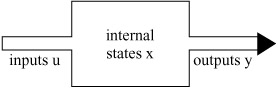
Figure 6.1 shows a general situation that is to be modelled. External influences (controls, raw material characteristics, environmental influences and disturbances) are contained in vector u. Available information (measurements, observations, other data) are contained in vector y. The vector x contains internal variables fundamental to the situation. x may be of no interest whatever, except as a building block to the modeller. Alternatively, x may be of great interest in its own right. We assume that there are available data sets { u i, y i} for the modeller to work on.


Figure 6.1: A general situation that is to be modelled

Approach ( 1) is to fit numerically a dynamic linear input-output model G i to each data set { u i, y i}. This is very easy but:

  1. G i may not fit the data well for any i. Such an effect may be encountered when the situation is non-linear and/or time varying.

  2. Different data sets { u j, y j}, { u k, y k} that are supposed to arise from the same mechanism may give rise to widely differing models G j, G k.

  3. Non-standard types of information, contained within the vectors u j, y i may be impossible to accommodate within a standard identification procedure.

Approach ( 2) is to construct a set of interlinked physically inspired equations,...

UNLIMITED FREE
ACCESS
TO THE WORLD'S BEST IDEAS

SUBMIT
Already a GlobalSpec user? Log in.

This is embarrasing...

An error occurred while processing the form. Please try again in a few minutes.

Customize Your GlobalSpec Experience

Category: Inertial Sensor Chips
Finish!
Privacy Policy

This is embarrasing...

An error occurred while processing the form. Please try again in a few minutes.