Control Theory, Second Edition

Chapter 12: State Estimation: The Kalman Filter and Prediction

12.1 State estimation - what it attempts to do

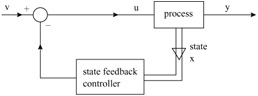
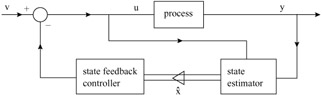
Many powerful feedback control strategies require the use of state feedback (Figure 12.1). However, in many important practical cases the state is not available to be fed back (it is said to be inaccessible). In such cases, a state estimator may be used to reconstruct the state from a measured output (Figure 12.2).


Figure 12.1: Application of state feedback

Figure 12.2: Application of state feedback when the state is inaccessible a state estimator reconstructs an estimate of the true state x

12.2 How a state estimator works - the Kalman filter

We assume that at time t = 0, the state x is exactly known, with value x 0. We have a process model that, given x 0, can make a model-based prediction T seconds into the future, to yield the prediction x p ( T).

We also have a measurement y and a known relation x m = ?y, applying at all times. In particular we have x m ( T) = ?y( T).

Both the model used for prediction and the measurement y are assumed to be subject to errors. Thus we have, at time T, two estimates of the true state x( T). These are:

  • x p( T), predicted by a model

  • x m( T), based on measurement.

The best estimate of x

UNLIMITED FREE
ACCESS
TO THE WORLD'S BEST IDEAS

SUBMIT
Already a GlobalSpec user? Log in.

This is embarrasing...

An error occurred while processing the form. Please try again in a few minutes.

Customize Your GlobalSpec Experience

Category: Industrial Valves
Finish!
Privacy Policy

This is embarrasing...

An error occurred while processing the form. Please try again in a few minutes.