Control Theory, Second Edition

Frequency response methods have a physical explanation that is readily understandable without any mathematics. In addition the methods are design-oriented, link easily between practical results and differential equation methods, and have been proven to work well in many practical design situations.
The 'home territory' for frequency response methods has traditionally been in servo-mechanism, process control and aerospace applications, and they have been rather resistant to applications outside these areas.
Frequency response methods have a distinguished history with Harold Nyquist (1932) and Harold Bode (1945) being credited with early fundamental work that remains relevant.
Control design in the frequency domain involves the following basic ideas:
The performance of a system H that is to be synthesised may be approximately characterised by its bandwidth, i.e. by the range of frequencies to which it will respond.
The bandwidth of any process G that is to be controlled may be measured experimentally or calculated analytically by straightforward means.
The necessary frequency characteristics of a controller D may be determined graphically from information on G and H, such that the performance in (i) is obtained.
Sufficient stability of the resulting control loop is easily taken care of as part of the design method.
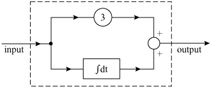
A linear dynamic system consists mathematically of the (repeated) operations: multiplication by a constant, differentiation, integration and summation,...