Control Theory, Second Edition

Chapter 3: Synthesis of Automatic Feedback Control Loops: A More Quantitative View

3.1 Feedback loops: further discussion

In automatic control a device called a controller issues commands that are physically connected to a process with the intention to influence the behaviour of the process in a particular way. The commands that will be issued by the controller in a particular set of circumstances are completely determined by the designer of the controller. Thus, automatic control can be seen to be completely pre-determined at the design stage.

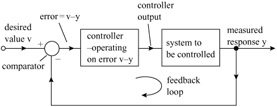
The controller may be driven by time alone or it may be driven in a more complex way by a combination of signals. In feedback control, the controller is error driven. That is, the controller receives a continuous measurement of the difference between required behaviour and actual behaviour and its output is some function of this error (Figure 3.1).


Figure 3.1: A feedback control loop

In this type of system, excellent results can be obtained in practice with very simple controllers indeed, even when operating under conditions where the system to be controlled is not well understood. Roughly speaking, we can imagine that the controller will keep on taking corrective action until the error is reduced to zero.

Notice that the output of the controller is a function of error v - y.

An alternative view of the arrangement of Figure 3.1 is that the user sees an artificially enhanced system that has been synthesised to meet his wishes. If we represent the controller by an operator D and the system to be controlled by...

UNLIMITED FREE
ACCESS
TO THE WORLD'S BEST IDEAS

SUBMIT
Already a GlobalSpec user? Log in.

This is embarrasing...

An error occurred while processing the form. Please try again in a few minutes.

Customize Your GlobalSpec Experience

Category: Flow Controllers
Finish!
Privacy Policy

This is embarrasing...

An error occurred while processing the form. Please try again in a few minutes.