Control Theory, Second Edition

Chapter 8: Some Practical Aspects of Control Design, Justification and Implementation

8.1 How efficient is it to control an unknown process by a controller that consists only of a high gain of value C that in the limit becomes a relay controller?

In view of the evident efficiency of feedback controllers in controlling unknown phenomena, is it not feasible to attempt control of all processes by some very simple standard strategy?

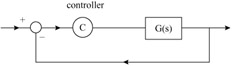
The simplest possible controller (Figure 8.1) involves just multiplication of the error by a scalar C; the overall transfer function is CG( s)/(1 + CG( s)) and if C is very high, then the overall transfer function is approximately


Figure 8.1: The simplest possible controller - a gain C

i.e. provided that C >> 1 near-perfect control can be obtained.

Q:

What happens as C ? ?? Will this give better and better control?

Answers

Q:

  1. As C is increased, the system may become unstable and unusable.

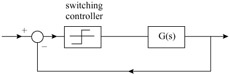
  2. Assuming that the system remains stable as C ? ? (another question left for the moment is when does this arise?), then we have arrived at a switched (relay) control system (Figure 8.2). Such a system does indeed have a high performance and the low cost of a switching controller also makes such systems economically attractive. However, there are two disadvantages of (infinite gain) switching systems:


    Figure 8.2: The limiting condition as c ? ? the controller becomes a relay

    1. They are essentially non-linear (for instance, they respond (initially) in the same...

UNLIMITED FREE
ACCESS
TO THE WORLD'S BEST IDEAS

SUBMIT
Already a GlobalSpec user? Log in.

This is embarrasing...

An error occurred while processing the form. Please try again in a few minutes.

Customize Your GlobalSpec Experience

Category: Flow Controllers
Finish!
Privacy Policy

This is embarrasing...

An error occurred while processing the form. Please try again in a few minutes.