Control Theory, Second Edition

A system that can change its state only at discrete points in time is called a discrete time system. Amongst the many examples of discrete time systems in everyday life could be mentioned the rates of exchange for foreign currencies charged by retail banks. Typically, these rates may be updated once every working day and stay constant otherwise.
Computers are the discrete time systems that interest us here; in particular, computers that perform the same calculation repeatedly. Such computers are used as controllers within closed loop systems. It turns out, perhaps surprisingly, that the discrete time effects of a computer, when used as a controller, are sufficiently profound to require a whole new batch of design techniques - these are introduced in this chapter.
To get a feel for what is going on, let us look at a very simple control loop first not containing a computer (case A) and secondly, containing a computer (case B).
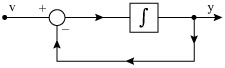
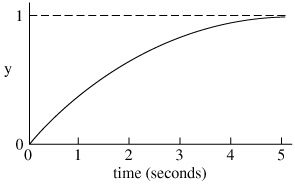
The control loop (case A) simply comprises an integrator with negative feedback (Figure 11.1). Everything is at rest and set at zero and then v is moved instantaneously from v = 0 to v = 1. Simple calculation will show that the system output y moves as shown (Figure 11.2).