Control Theory, Second Edition

Most closed loop systems become unstable as gains are increased in attempts to achieve high performance. It is therefore correct to regard stability considerations as forming a rather general upper limit to control system performance. Also, as will be discussed in this chapter, achievable rates of change are always constrained in practice by equipment limitations.
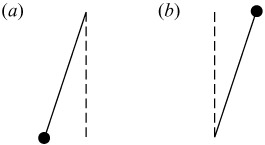
A stable system is one that, when perturbed from an equilibrium state, will tend to return to that equilibrium state. Conversely, an unstable system is one that, when perturbed from equilibrium, will deviate further, moving off with ever increasing deviation (linear system) or possibly moving towards a different equilibrium state (non-linear system) (Figure 7.1).
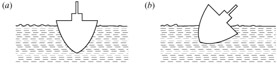
All usable dynamical systems are necessarily stable - either they are inherently stable or they have been made stable by active design means. For example, a ship should ride stably with its deck horizontal and tend to return to that position after being perturbed by wind and waves (Figure 7.2).
Stability occupies a key position in control theory for the reason that the upper limit of the performance of afeedback control system is often set by stability considerations, although most practical designs will be well away from the stability limit to avoid excessively oscillatory responses.
It is possible to check whether a system is stable or not by examining the...