Control Theory, Second Edition

Chapter 10: Multivariable Linear Processes

10.1 Transfer function representations

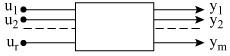
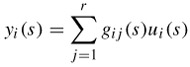
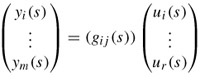
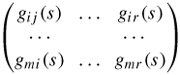
By a multivariable process we mean a process with several (say r) inputs and several (say m) outputs (Figure 10.1). In general, every input is connected to every output through some dynamic coupling. We can pretend that the ith output y i is connected to the jth input u i through a transfer function g ij( s). Because of our assumption of linearity, superposition is valid and therefore we can write


Figure 10.1: A multivariate process a system with r inputs and m outputs
(10.1)

or


where the notation ( g ij( s)) indicates the matrix


Multivariable matrix formulations are used for control system design, particularly using the inverse Nyquist array methods pioneered by Rosenbrock (1971, 1974) and Macfarlane (1970). The methods make central use of the concept of diagonal dominance. A completely diagonal matrix of transfer functions (with zeros everywhere except on the leading diagonal) would clearly indicate just a set of non-interconnected single-input single-output systems - each such system could be dealt with separately and there would be no need for any special 'multivariable' treatment.

In practice, multivariable closed loop systems can rarely be diagonalised for all frequencies by choice of controller. However, they can be made diagonally dominant; that is, the diagonal terms can be made large compared with the off-diagonal terms. It is a key result of Rosenbrock that interaction between a set of individually stable diagonal elements will not cause overall...

UNLIMITED FREE
ACCESS
TO THE WORLD'S BEST IDEAS

SUBMIT
Already a GlobalSpec user? Log in.

This is embarrasing...

An error occurred while processing the form. Please try again in a few minutes.

Customize Your GlobalSpec Experience

Category: CRT Monitors
Finish!
Privacy Policy

This is embarrasing...

An error occurred while processing the form. Please try again in a few minutes.