Handbook Of Thermoluminescence

D: Defects Dosimetric Trap

Defects

Materials of interest in thermoluminescent dosimetry are principally insulators in which conduction electrons are entirely due to absorbed radiation energy. Examples of such insulators are the cubic structured alkali halides, such LiF and NaCl.

A crystal is an agglomerate of atoms or molecules characterized by a 3-fold periodicity. To describe completely a crystal one has to define the positions of atoms (or molecules) inside a unit cell, built a three-vector of arbitrary origin. All the atoms of the crystal will be obtained from the atoms of the unit cell by all the translations :

(1)

where ? i represents all the positive and negative integers.

A crystal defined by Eq.(1) is termed ideal. Thermal vibrations disturb the periodicity and make it impossible to obey Eq.(1), so the crystal is now called imperfect. A further limitation to Eq.(1) is the finite crystal size. Crystals are limited by free surfaces which are the first type of crystal defect. A crystal which has free surfaces and probably other defects, is a real crystal.

Since alkali halides and their imperfections are particularly suitable for understanding luminescence phenomena, they will be used to discuss the behavior of a real crystal, all defects of which can potentially act as traps for the charge carriers created by secondary charged particles during irradiation.

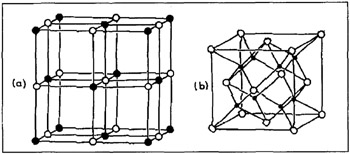
The alkali halides structure consists of an orderly arrangement of alkali and halide ions, one after another, alternating in all three directions. Figure 1 shows the structure of two ideal crystals.


Fig.

UNLIMITED FREE
ACCESS
TO THE WORLD'S BEST IDEAS

SUBMIT
Already a GlobalSpec user? Log in.

This is embarrasing...

An error occurred while processing the form. Please try again in a few minutes.

Customize Your GlobalSpec Experience

Category: TLD and Film Badges
Finish!
Privacy Policy

This is embarrasing...

An error occurred while processing the form. Please try again in a few minutes.