Handbook Of Thermoluminescence

(from Peak shift to Properties of the maximum conditions)
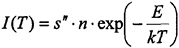
The TL intensity for first (Randall and Wilkins model) and second (Garlick and Gibson model) order of kinetics are respectively
| (1) | |
and
| (2) | |
where n is the trapped carrier concentration, s is the frequency factor,
is the so-called pre-exponential factor, with N the available trap concentration.
Equation (2) can be rewritten as
| (3) | |
with s"=s ?n, which is equivalent to s in the first order case.
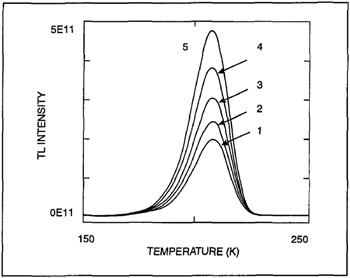
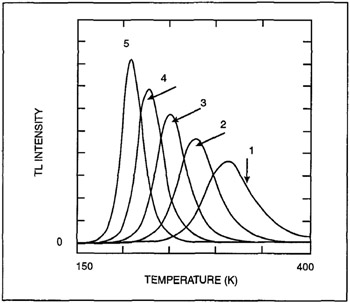
Considering Eqs. (1) to (3), it can be seen that the peak temperature at the maximum, T M , depends on E and s, s ? or s ?; then, if n changes, increase or decreases, a first-order peak remains in the same position, but a second-order peak shifts, i.e., to higher temperatures as n decreases because the variation in s ?.
Figures (1) and (2) show the different behaviors expected for glow peaks following a first-order kinetics or a second-order.
Perovskite compounds corresponding to the general formula ABX 3 (where A is an alkali metal, B is an alkaline earth metal, and X...