Handbook Of Thermoluminescence

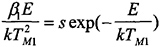
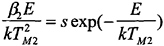
-Bohum [1], Porfianovitch [2] and Booth [3], working independently, proposed a method based on two different heating rates for a first-order peak. Taking into account the condition at the maximum and using two different heating rates one obtains:
| (1) | |
| (2) | |
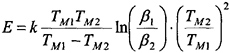
from which, by eliminating s, E is obtained according to the following expression
| (3) | |
Therefore, in the assumption b=1, E is easily evaluated by measuring the two peak temperatures corresponding to the maximum TL intensity for the two heating rates. If T M can be measured within an accuracy of 1 C, the method yields E within 5%. The value of s can then be calculated by substituting the numerical value of E in one of the two equations (1) or (2).
1. Bohum A., Czech. J. Phys. 4 (1954) 91
2. Porfianovitch I.A., J. Exp. Theor. Phys. SSSR, 26 (1954) 696
3. Booth A.H., Canad. J. Chem. 32 (1954) 214
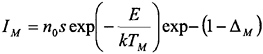
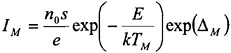
Chen and Winer reported a method using an approximation for the integral which appears in the first-order expression of I(T). In fact, the integral can be approximated as follows
| (1) | |
where
![]()
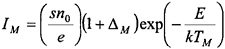
The insertion of (1) into the first-order expression for I(T) yields
| (2) | |
Inserting now the condition at the maximum in Eq. (2), one obtains
or
and then
| (3) | |
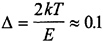
Even with large variations of ?,...