Temperature Gradient in a TL Sample
In case high heating rates are used during readout, a temperature difference between the bottom and the top of a sample can be observed and the glow peak becomes broader [1,2].
In case a temperature gradient across a TL sample is ignored, the TL intensity is given by
| (1) | 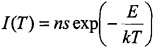
|
On the other hand, assuming a constant temperature gradient across a TLD sample, the emission can be written as
| (2) | 
|
where
T 2=temperature of the sample
n( T 2+ ?)=density of trapped charge carriers at temperature T 2+ ? at a given position within the sample.
Assuming a linear time dependence of temperature at each position in the sample and neglecting the energy dissipation to the surroundings, we can write, for each position in the sample:
| (3) | 
|
where  and ? ? are, respectively, the effective starting temperature and the effective heating rate in the sample, and ? ?t ?= ?.
Indicating with dn the difference of n between two positions, corresponding to a difference in temperature of dT at a certain time, we can write
| (4) | 
|
so that, the quantity n( T 2+ ?) can be approximated by
| (5) | 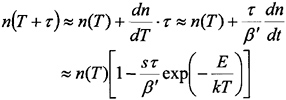
|
Using last Eq.(5), Eq.(2) becomes
which can be approximated as
| (6) | 
|
and again, solving the integral:
| (7) | 
|
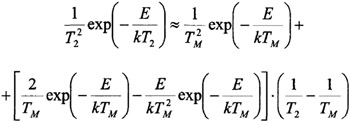
The last exponential on the right of Eq.(7) can be developed into powers of  around
  :
:
and then Eq.(7) becomes


 TABLE OF CONTENTS