Keating Method (First-Order, s=s(T))
Keating has proposed a method to determine E, for the first-order, when s is supposed to be temperature dependent [1].
The equation giving the TL intensity, when the frequency factor is temperature dependent, is the following:
| (1) | 
|
Putting n o s o= I o and making the logarithm of Eq.(1), one gets
| (2) | 
|
Differentiation of this equation with respect to T, and setting the derivative at the maximum equal to zero, yields
from which
| (3) | 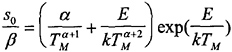
|
Remembering that the integral in Eq.(1) can be evaluated by an asymptotic series, in this case we have
| (4) | 
|
with
Thus, Eq.(2) becomes
| (5) | 
|
Inserting in Eq.(5) the expression (3), we get
| (6) | 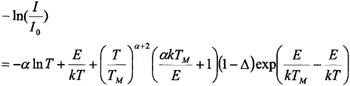
|
Using now the temperature T 1 and T 2 when I=I M/2, the following parameters are defined:
| (7) | 
|
Hence, the following expressions, with T 1 and T 2 respectively, can be obtained
| (8a) | 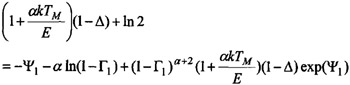
|
| (8b) | 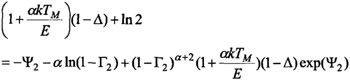
|
with
| (9a) | 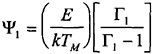
|
| (9b) | 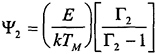
|
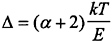
Since ?  1 for E/kT>10 the expressions ( ?+2) kT 1/ E and ( ?+2) kT 2/ E have been taken equal to ?=( ?+2 )kT M /E.
Equations (8a, b) can be resolved numerically for ? 1 and ? 2 for values of a =0, 2 and E/kT M between 10 and 35. Analysis of the data shows that E can be found by the following linear equation
| (10) | 
|
with
?= ? 1+


 TABLE OF CONTENTS