Handbook Of Thermoluminescence

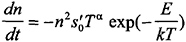
The detrapping rate in this case is given by [1,2,3]
| (1) | |
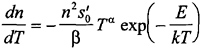
Using a linear heating rate, Eq.(1) becomes
| (2) | |
and the solution is then
| (3) | |
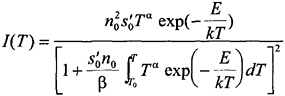
while the intensity is given by
| (4) | |
1. Chen R. and Kirsh Y., Analysis of Thermally Stimulated Processes (Pergamon Press, 1981)
2. McKeever S.W.S., Thermoluminescence of Solids (Cambridge University Press, 1985)
3. Furetta C. and Weng P.S., Operational Thermoluminescence Dosimetry (World Scientific Publ., 1998)
The self-dose arises from the radioactive content of the thermoluminescent materials. With fading, the self-dose is an important factor in environmental radiation monitoring and it is strongly dependent on the packing materials constituting the dosimeter. Self-dose and fading are two effects in competition between them.
A precise estimation of self-dose effect needs an accurate experiment. A method of estimating accurately both self-dose and fading under conditions similar to the ones encountered in environmental monitoring applications consists of leaving a batch of TLDs in a sufficiently thick lead shield of about 5 cm to stop most of the external irradiations (only hard components of the cosmic rays will contribute to the radiation field inside the lead shield).
The experimental procedure is the same of the previous one and, as before, we have again three sub-groups of TLDs, group A, B and C.
After having done all the initial procedures, group A is irradiated at the test dose D t and stored inside the...