Randall-Wilkins Model (First-Order Kinetics)
In 1945, Randall and Wilkins used extensively a mathematical representation for each peak in a glow curve, starting from studies on phosphorescence. Their mathematical treatment was based on the energy band model and yelds the well-known first order expression.
The simplest model used for the theoretical treatment consists of two delocalized bands, i.e. conduction band (CB) and valence band (VB), and two localized levels (metastable states), one acting as a trap, T, and the other acting as a recombination center (R). The distance between the trap T and the bottom of the CB is called activation energy or trap depth: E. This energy is the energy required to liberate a charge, i.e., an electron, which is trapped in T. The probability p, per unit of time, that a trapped electron will escape from the trap, or the probability rate of escape per second, is given by the Arrhenius equation, having considered that the electrons in the trap have a Maxwellian distribution of thermal energies
| (1) | 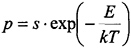
|
where
E is the trap depth (eV), k the Boltzmann s constant, T the absolute temperature (K), s the frequency factor (sec ?1), depending on the frequency of the number of hits of an electron in the trap, seen as a potential well.
The life time, ?, of the charge carrier in the metastable state at temperature T, is given by
| (2) | 
|
If n is...


 TABLE OF CONTENTS