Balarin [1,2] deduced some expressions for determining the activation energy, based on the quantity ?=T 2 ? T 1 , where T 1 and T 2 correspond to the temperatures on either side of T M , corresponding to half intensity. In the following the Balarin s original symbolism is used.
He started from the following general rate equation
| (1) | 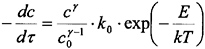
|
with  and where
The processes governed by Eq.(1) are enhanced when the temperature of the system is raised continuously with a constant heating rate  . Equation (1) can then be transformed as
| (2) | 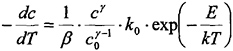
|
The maximum condition is then obtained
| (3) | 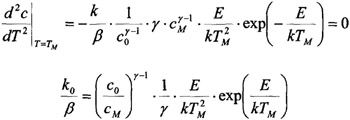
|
Considering the following quantities:
Eq.(2) becomes
| (4) | 
|
Integration of Eq.(4), starting at t=0, T= 0, y=0 and C 0=1 up to C(T), gives, for various values of ?:
| (5) | 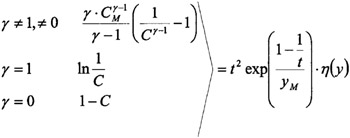
|
where
| (6) | 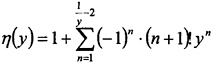
|
is a correction function which is always close to unity, ?(y) ?1.
Using expression (6) in (5), we obtain
| (7) | 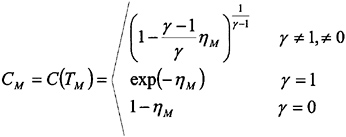
|
| (8) | 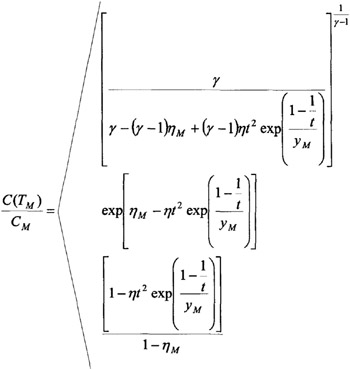
|
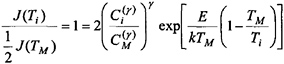
The temperature positions T i= T 1 and T 2 are obtained when the intensity  is half of the maximum intensity. By means of Eq.(1) or (4), we get
| (9) | 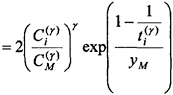
|
where the subscript ( ?) indicates the individual solution for every distinct kinetic order.
Inserting (8) in (9), expressions...

 TABLE OF CONTENTS