Lushchik [1] also proposed a method based on the glow-peak shape for both first- and second-order kinetics. Introducing the parameter ?= T 2 ?T M , a glow-peak can be approximated to a triangle as shown in Fig. 8.
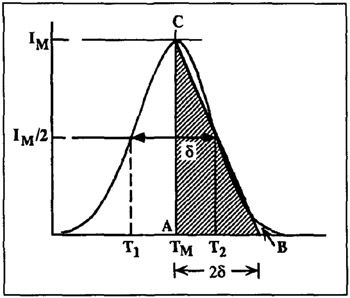 Fig. 8: Approximation of a glow-peak in a triangle.
 In this case, with a good approximation, one has
| (1) | 
|
where n M is the carrier concentration at the maximum.
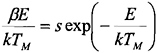
For the first-order kinetics, the equation
at the maximum point becomes
| (2) | 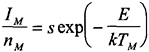
|
Using the condition at the maximum
Eq.(2) gets
| (3) | 
|
The substitution of expression (1) in (3) allows to obtain the Lushchik s expression for the activation energy for the first-order process:
| (4) | 
|
The Lushchik formula for a second-order kinetics is obtained using the solution for n, valid for a second order kinetics, replacing n with n M :
| (5) | 
|
Using now the expression for the intensity at the maximum, I M , and doing the ratio between I M and n M , one has
| (6) | 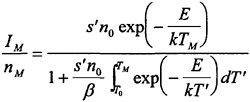
|
The insertion of the maximum condition for the second order in Eq.(6) yields
| (7) | 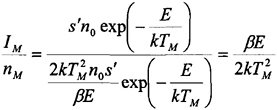
|
Using again Eq.(1) and rearranging, the expression of Lushchik for the second order is obtained:
| (8) | 
|
Chen [2] modified the two previous equations for a better accuracy in the E value by multiplying by 0.978 Eq.(4) and by 0.853 Eq.(8), i.e
The frequency factor for the first-order process is obtained by...


 TABLE OF CONTENTS