Garlick-Gibson Model (Second-Order Kinetics)
In 1948 Garlick and Gibson, in their studies on phosphorescence, considered the case when a free charge carrier has probability of either being trapped or recombining within a recombination center. The term second order kinetics is used to describe a situation in which retrapping is present.
They assumed that the escaping electron from the trap has equal probability of either being retrapped or of recombining with hole in a recombination center.
Let us indicate:
-
N=concentration of traps,
-
n=electrons in N,
-
m=concentration of recombination centers,
-
n=m for charge neutrality condition.
The probability that an electron escapes from the trap and recombine in a recombination center is
| (1) | 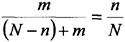
|
So, the intensity of phosphorescence, I, is given by the rate of decrease of the occupied trap density, resulting in the recombination of the released electrons with hole in the recombination centers:
| (2) | 
|
where ? is the mean trap lifetime.
Equation (2) can be rewritten as
| (3) | 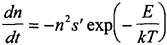
|
The quantity s ?=s/N is called pre-exponential factor and it is a constant having dimensions of cm 3sec ?1. Equation (3) is different from that one obtained in the case of first order kinetics, where the recombination probability is equal to 1, since no retrapping is possible.
From Eq.(3), by integration with constant temperature T, we obtain:
| (4) | 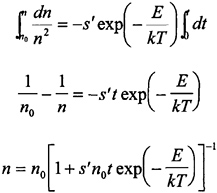
|
and then, the intensity I(t) is:
| (5) | 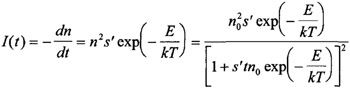
|
which describes the hyperbolic decay of phosphorescence.
Otherwise, the luminescence intensity of an irradiated phosphor...

 TABLE OF CONTENTS