Handbook Of Thermoluminescence

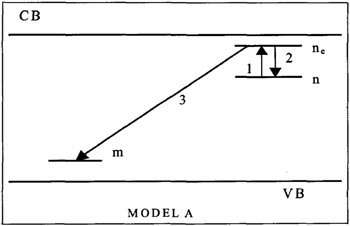
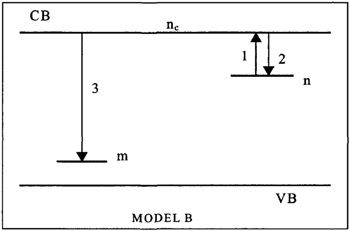
Halperin and Braner [1] proposed a method, for determining the activation energy, based on the temperatures on either side of the temperature at the maximum, corresponding to the half maximum intensity of the peak. They considered the luminescence emission as mainly due to two different kinds of recombination processes. In the first one the electrons raise to an excited state within the forbidden gap below the conduction band and recombine with holes by tunnelling process (model A). In the second process, the recombination takes place via conduction band (model B). Figures 4 and 5 show the two recombination processes treated in the text.
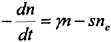
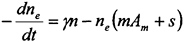
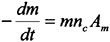
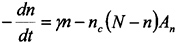
The kinetics equations are formuled as shown below:
Model A
| (1a) | |
| (1b) | |
| (1c) | |
Model B
| (2a) | |
| (2b) | |
| (2c) | |
where
n e=concentration of electrons in the excited states N e,
n c=concentration of electrons in the conduction band (CB),
n=number of trapped electrons in the electron traps N,
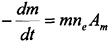
m=number of trapped holes in hole traps M,
A m=probability of recombination,
A n=probability of retrapping,
![]()
s=frequency factor or probability per second of retrapping.
In Model B one assumes that s is temperature dependent, i.e. s=s 0 T 2. Assuming that transition...