Chemical Engineering License Review, Second Edition

This text contains 146 problems with detailed step-by-step solutions, and is an ideal study guide and the first truly practical, no-nonsense review for the difficult PE Exam.
 TABLE OF CONTENTS
 The nature of the flow of a fluid in a pipe depends upon the Reynolds number which is defined as

| where D | = inside diameter of pipe, ft |
| u | = velocity of fluid, ft/s |
| ? | = density of fluid, lb/ft 3 |
| G | = mass velocity, lb/h ft 2 |
| ? | = viscosity, lb/ft s for Du ?/ ? and lb/ft h for DG/ ? |
Flow regimes are defined as follows:

Distribution of Velocities For fluids flowing through a pipe, the velocity distribution will depend upon the type of flow. For the laminar or viscous flow, the velocity distribution is truly parabolic.
Laminar Flow of Newtonian Fluids in Cylindrical Pipes Starting from the definition of viscosity and by considering the shear stress of an incompressible fluid through the tube, it can be shown that

where u is the local velocity at r and u max is the maximum velocity at r = 0 (center of tube). For the flow of a fluid in a tube, the average velocity is given by [1d]

Turbulent Flow For turbulent flow, [1d]

The relationship between u av/ u max versus Reynolds number Du ?/ ? is available in a graphical form. [1d]
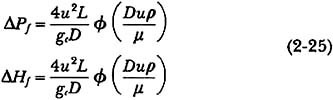
Frictional Losses in Circular Pipes The frictional losses for flowing fluids are a function of Reynolds number. ? P and the head loss from friction are given by
A more...