Chemical Engineering License Review, Second Edition
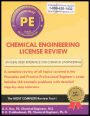
This text contains 146 problems with detailed step-by-step solutions, and is an ideal study guide and the first truly practical, no-nonsense review for the difficult PE Exam.
 TABLE OF CONTENTS
 Drying generally refers to the removal of small amounts of volatile liquid, usually water, from solids by evaporation into a gas stream. Many types of drying equipment are available, e.g., tray, turbo, flash, fluid bed, spray, rotary, and thin film.
When a wet solid is brought in contact with air, the solid tends to lose moisture if the humidity of the air is lower than the humidity corresponding to the moisture content of the solid. If the air is more humid than the solid in contact with it, the solid will gain moisture until an equilibrium is attained.
Equilibrium Moisture The portion of water in the wet solid that cannot be removed by the air in its contact is called the equilibrium moisture. Since an equilibrium is reached between the air and the solid, there is no humidity driving force between them.
Bound water in a solid exerts an equilibrium vapor pressure lower than that of pure water at the same temperature. Unbound water exerts the equilibrium vapor pressure of pure water at the prevailing conditions.
Free Moisture The free moisture is the amount of water in a wet solid in excess of the equilibrium moisture. Thus

| where X | = free moisture content of wet solid, lb/lb dry solid |
| X T | = total moisture content of wet solid, lb/lb dry solid |
| X* | = equilibrium moisture content of solid, lb/lb dry solid |
When the drying rates are determined and plotted against the moisture content...