Chemical Engineering License Review, Second Edition

This text contains 146 problems with detailed step-by-step solutions, and is an ideal study guide and the first truly practical, no-nonsense review for the difficult PE Exam.
 TABLE OF CONTENTS
 Applying the principle of conservation of energy (first law of thermodynamics) to a flowing fluid (Fig. 2-4), the following Bernoulli equation is obtained for the steady flow of a fluid:

| where u A, u B | = velocities of fluid, ft/s, at A and B, respectively |
| Z A, Z B | = liquid heights at A and B with respect to a datum plane, ft |
| P A, P B | = pressures at A and B, lbf/ft 2 |
| ? A, ? B | = densities of fluids at A and B, lb/ft 3 |
| u 2/2 g c | = kinetic head, ft lbf/lb |
| F | = energy loss due to friction, ft lbf/lb |
| W | = work done by the pump on the fluid ft lbf/lb |
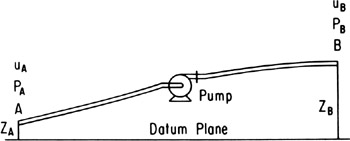
The various terms in the Bernoulli equation must be expressed in the same units as energy (ft lbf/lb). Normally g/ g c ? 1, and therefore g/ g c can be dropped from the terms containing Z.
A shown in Fig. 2-5, water flows through the pipe. If the contraction loss is half a velocity head based on the velocity at B, calculate the velocity in feet per second and diameter in inches at B. Neglect the pressure drop due to friction.
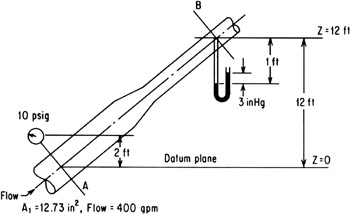
Solution. Apply the Bernoulli equation between the...