Chemical Engineering License Review, Second Edition

This text contains 146 problems with detailed step-by-step solutions, and is an ideal study guide and the first truly practical, no-nonsense review for the difficult PE Exam.
 TABLE OF CONTENTS





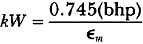
| where W | = weight rate of flow, lb/h |
| TDH | = required total dynamic head of the pump, ft |
| P 1 | = pressure in suction vessel, psia |
| P 2 | = pressure in discharge vessel, psia |
| ? P f1 | = total pressure drop in suction line, psi |
| ? P f2 | = total pressure drop in discharge line, psi |
| P v | = vapor pressure at pumping temperature, psia |
| Q | = pump capacity, gpm |
| Z 1 | = static suction head, ft |
| Z 2 | = static discharge head, ft |
| hp | = motor horsepower |
| hhp | = hydraulic horsepower |
| bhp | = brake horsepower |
| ? | = efficiency of pump |
| ? m | = motor efficiency |
| P s | = suction pressure, psia |
| P d | = discharge pressure, psia |
| s | = specific gravity |
Actual motor size selection depends upon available standard motor sizes. This results in having motors of ratings 110 to 125 percent of the rated brake horsepower of the pump.
Pump Affinity Laws These are the relationships among the capacity Q, head H, power bhp, impeller diameter D, and speed of revolution (in revolutions per minute) of centrifugal pumps and fans.
1. Effect of Speed Change When D Is Constant.
Capacity:

Head:

Power:

NPSH required:

These laws can be used to determine the performance curve at another rpm level if the performance curve is available at a known rpm.
2. Effect of Impeller Diameter Change. Within the same pump at a constant speed, the following relations apply...