Chemical Engineering License Review, Second Edition

This text contains 146 problems with detailed step-by-step solutions, and is an ideal study guide and the first truly practical, no-nonsense review for the difficult PE Exam.
 TABLE OF CONTENTS
 Given the filtration conditions and the specifications of a filter, the common problems to be solved are (1) the amount of the filtrate obtainable in a given time, (2) the amount of the solvent that can be passed through the cake in a given time, and (3) concentration of the recovered material in the wash solvent.
Filtration can be carried out in two ways: (1) constant-pressure filtration, i.e., the filtration rate varies, and (2) constant-rate filtration in which the ? P varies. Two methods are available to treat filtration problems. They are (1) Ruth's equation [1] and (2) the Kozeny-Carman [2] relation.
To establish Ruth's equation, the following variables are first defined:
V = filtrate, ft 3
? = filtrate density, lb/ft 3
W = filterable solids, lb
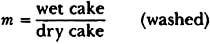
x = mass fraction of the solids in a slurry
Using these definitions, the following relations are developed:


from which


The Hagen-Poiseuille equation for the laminar flow of fluids in tubes of circular cross section is given by

Assuming Eq. (11-2) applies to the filtrate flow, it can be shown that the rate of filtration is given by

| where A | = total filtering area, ft 2 |
| ? | = time of filtration, h |
| ? | = viscosity of filtrate, lb/ft h |
| L | = thickness of cake, ft |
| ? P C | = pressure drop across cake, lbf/ft 2 |
| R C | = resistance of cake = 32 L/ g cD 2 e, h 2 lbf/ft |