Chemical Engineering License Review, Second Edition
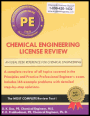
This text contains 146 problems with detailed step-by-step solutions, and is an ideal study guide and the first truly practical, no-nonsense review for the difficult PE Exam.
 TABLE OF CONTENTS
 A number of process design aspects other than those discussed in the previous chapters have received some attention from time to time in the P.E. examinations. These are: process control, plant safety, explosion protection, waste treatment and disposal, water and energy conservation, and plant environmental dust and pollution control. Treatment of all of these subjects is beyond the limited space of this book. Therefore, only the subject of process control is very briefly dealt with in this chapter.
A control system or scheme is characterized by an output variable (e.g., temperature) that is automatically controlled through the manipulation of inputs (input variables). In an open-loop control system, the inputs to the process are regulated independently without using the controlled output variable to adjust the inputs. In a closed-loop or feedback control system, the output controlled variable is used to adjust the inputs to the process. In a feed-forward control, the measurement of one input variable is used to adjust another input variable.
The method of cascade control is frequently used to decrease the process upsets. It involves the use of the output of a primary controller to adjust the set point of a secondary controller and is commonly used in the feedback control. The ratio and selector controls are two other control modes which require two or more interconnected instruments.
In control-system analysis, the block diagrams are used to show the functional relationship between the various parts of the system. Each part is represented by a...