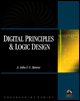
Digital Principles and Logic Design

5.4: SUBTRACTORS

5.4 SUBTRACTORS

Subtraction is the other basic function of arithmetic operations of information-processing tasks of digital computers. Similar to the addition function, subtraction of two binary digits consists of four possible elementary operations, which are 0 0 = 0, 0 1 = 1 with borrow of 1, 1 0 = 1, and 1 1 = 0. The first, third, and fourth operations produce a subtraction of one digit, but the second operation produces a difference bit as well as a borrow bit. The borrow bit is used for subtraction of the next higher significant bit. A combinational circuit that performs the subtraction of two bits as described above is called a half-subtractor. The digit from which another digit is subtracted is called the minuend and the digit which is to be subtracted is called the subtrahend. When the minuend and subtrahend numbers contain more significant digits, the borrow obtained from the subtraction of two bits is subtracted from the next higher-order pair of significant bits. Here the subtraction operation involves three bits the minuend bit, subtrahend bit, and the borrow bit, and produces a different result as well as a borrow. The combinational circuit that performs this type of addition operation is called a full-subtractor. Similar to an adder circuit, a full-subtractor combinational circuit can be developed by using two half-subtractors.

5.4.1 Design of Half-subtractors

A half-subtractor has two inputs and two outputs. Let the input variables minuend and subtrahend be designated as X and Y respectively, and output functions...

UNLIMITED FREE
ACCESS
TO THE WORLD'S BEST IDEAS

SUBMIT
Already a GlobalSpec user? Log in.

This is embarrasing...

An error occurred while processing the form. Please try again in a few minutes.

Customize Your GlobalSpec Experience

Category: Logic Adders
Finish!
Privacy Policy

This is embarrasing...

An error occurred while processing the form. Please try again in a few minutes.