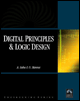
Digital Principles and Logic Design

Chapter 9: Counters

9.1 INTRODUCTION

Counters are one of the simplest types of sequential networks. A counter is usually constructed from one or more flip-flops that change state in a prescribed sequence when input pulses are received. A counter driven by a clock can be used to count the number of clock cycles. Since the clock pulses occur at known intervals, the counter can be used as an instrument for measuring time and therefore period of frequency. Counters can be broadly classified into three categories:

  1. Asynchronous and Synchronous counters.

  2. Single and multimode counters.

  3. Modulus counters.

The asynchronous counter is simple and straightforward in operation and construction and usually requires a minimum amount of hardware. In asynchronous counters, each flip-flop is triggered by the previous flip-flop, and hence the speed of operation is limited. In fact, the settling time of the counter is the cumulative sum of the individual settling times of the flip-flops. This type of counters is also called ripple or serial counter.

The speed limitation of asynchronous counters can be overcome by applying clock pulses simultaneously to all of the flip-flops. This causes the settling time of the flip-flops to be equal to the propagation delay of a single flip-flop. The increase in speed is usually attained at the price of increased hardware. This type of counter is also known as a parallel counter.

The counters can be designed such that the contents of the counter advances by one with each clock pulse; and is...

UNLIMITED FREE
ACCESS
TO THE WORLD'S BEST IDEAS

SUBMIT
Already a GlobalSpec user? Log in.

This is embarrasing...

An error occurred while processing the form. Please try again in a few minutes.

Customize Your GlobalSpec Experience

Category: Logic Counters
Finish!
Privacy Policy

This is embarrasing...

An error occurred while processing the form. Please try again in a few minutes.