Digital Principles and Logic Design

5.9: FOUR-BIT BINARY PARALLEL ADDER

5.9 FOUR-BIT BINARY PARALLEL ADDER

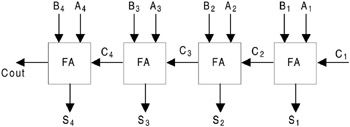
In the preceding section, we discussed how two binary bits can be added and the addition of two binary bits with a carry. In practical situations it is required to add two data each containing more than one bit. Two binary numbers each of n bits can be added by means of a full adder circuit. Consider the example that two 4-bit binary numbers B 4B 3B 2B 1 and A 4A 3A 2A 1 are to be added with a carry input C 1. This can be done by cascading four full adder circuits as shown in Figure 5.48. The least significant bits A 1, B 1, and C 1 are added to the produce sum output S 1 and carry output C 2. Carry output C 2 is then added to the next significant bits A 2 and B 2 producing sum output S 2 and carry output C 3. C 3 is then added to A 3 and B 3 and so on. Thus finally producing the four-bit sum output S 4S 3S 2S 1 and final carry output Cout. Such type of four-bit binary adder is commercially available in an IC package.


Figure 5.48

For the addition of two n bits of data, n numbers of full adders can be cascaded as...

UNLIMITED FREE
ACCESS
TO THE WORLD'S BEST IDEAS

SUBMIT
Already a GlobalSpec user? Log in.

This is embarrasing...

An error occurred while processing the form. Please try again in a few minutes.

Customize Your GlobalSpec Experience

Category: Logic Adders
Finish!
Privacy Policy

This is embarrasing...

An error occurred while processing the form. Please try again in a few minutes.