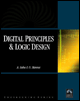
Digital Principles and Logic Design

Glossary

A

Access Time:
Time between the memory receiving a new input address and the output data s becoming available in a read operation.
Active Load:
A transistor that acts as a load for another transistor.
Active Low:
The low state is the one that causes the circuit to become active rather than the high state.
Active Power Dissipation:
The power dissipation of a device under switching conditions. It differs from static power dissipation because of the large current spikes during output transitions.
ADC:
Analog-to-digital converter.
Addend:
Number to be added to another.
Alphanumeric Codes:
Codes that present numbers, letters, punctuation marks, and special characters.
Arithmetic-Logic Unit (ALU):
Digital circuit used in computers to perform various arithmetic and logic operations.
Assert:
To activate. If an input line has a bubble on it, the input can be asserted by making it low.
Astable Multivibrator:
Digital circuit that oscillates between two unstable output states.
Asynchronous Transfer:
Data transfer performed without the aid of a clock.
Augend:
Number to which the addend is added.

B

Bilateral Switch:
CMOS switch which acts like a single-pole, single-through switch (SPST) controlled by an input logic level.
Binary Numbers:
A number code that uses only the digits 0 and 1 to represent quantities.
Bipolar:
Having two types of charge carriers; free electrons and holes.
Bistable Multivibrator:
Name that is sometimes used to describe a flip-flop.
Bit:
An abbreviation for binary digit.

UNLIMITED FREE
ACCESS
TO THE WORLD'S BEST IDEAS

SUBMIT
Already a GlobalSpec user? Log in.

This is embarrasing...

An error occurred while processing the form. Please try again in a few minutes.

Customize Your GlobalSpec Experience

Category: Arithmetic Logic Units (ALU)
Finish!
Privacy Policy

This is embarrasing...

An error occurred while processing the form. Please try again in a few minutes.