Digital Principles and Logic Design

5.11: DECODERS

5.11 DECODERS

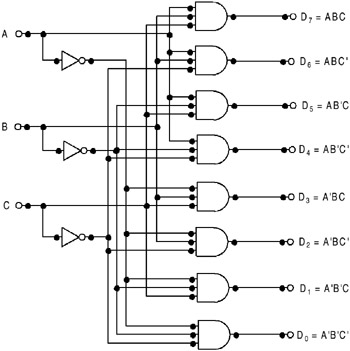
In a digital system, discrete quantities of information are represented with binary codes. A binary code of n bits can represent up to 2 n distinct elements of the coded information. A decoder is a combinational circuit that converts n bits of binary information of input lines to a maximum of 2 n unique output lines. Usually decoders are designated as an n to m lines decoder, where n is the number of input lines and m (=2 n) is the number of output lines. Decoders have a wide variety of applications in digital systems such as data demultiplexing, digital display, digital to analog converting, memory addressing, etc. A 3-to-8 line decoder is illustrated in Figure 5.60.


Figure 5.60

The 3-to-8 line decoder consists of three input variables and eight output lines. Note that each of the output lines represents one of the minterms generated from three variables. The internal combinational circuit is realized with the help of INVERTER gates and AND gates.

The operation of the decoder circuit may be further illustrated from the input output relationship as given in the table in Figure 5.61. Note that the output variables are mutually exclusive to each other, as only one output is possible to be logic 1 at any one time.

Input variables

Outputs

A

B

C

D 0

D 1

D 2

D 3

D 4

D 5

D 6

D 7

0

0

0

UNLIMITED FREE
ACCESS
TO THE WORLD'S BEST IDEAS

SUBMIT
Already a GlobalSpec user? Log in.

This is embarrasing...

An error occurred while processing the form. Please try again in a few minutes.

Customize Your GlobalSpec Experience

Category: Logic Decoders and Demultiplexers
Finish!
Privacy Policy

This is embarrasing...

An error occurred while processing the form. Please try again in a few minutes.