Digital Principles and Logic Design

5.10: MAGNITUDE COMPARATOR

5.10 MAGNITUDE COMPARATOR

A magnitude comparator is one of the useful combinational logic networks and has wide applications. It compares two binary numbers and determines if one number is greater than, less than, or equal to the other number. It is a multiple output combinational logic circuit. If two binary numbers are considered as A and B, the magnitude comparator gives three outputs for A > B, A < B, and A = B.

For comparison of two n-bit numbers, the classical method to achieve the Boolean expressions requires a truth table of 2 2 n entries and becomes too lengthy and cumbersome. It is also desired to have a digital circuit possessing with a certain amount of regularity, so that similar circuits can be applied for the comparison of any number of bits. Digital functions that follow an inherent well-defined regularity can usually be developed by means of algorithmic procedure if it exists. An algorithm is a process that follows a finite set of steps to arrive at the solution to a problem. A method is illustrated here by deriving an algorithm to design a 4-bit magnitude comparator.

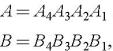
The algorithm is the direct application of the procedure to compare the relative magnitudes of two binary numbers. Let us consider the two binary numbers A and B are expanded in terms of bits in descending order as


where each subscripted letter represents one of the digits in the number. It is observed from the bit contents...

UNLIMITED FREE
ACCESS
TO THE WORLD'S BEST IDEAS

SUBMIT
Already a GlobalSpec user? Log in.

This is embarrasing...

An error occurred while processing the form. Please try again in a few minutes.

Customize Your GlobalSpec Experience

Category: Logic Comparators
Finish!
Privacy Policy

This is embarrasing...

An error occurred while processing the form. Please try again in a few minutes.