Electromagnetics, Microwave Circuit, and Antenna Design for Communications Engineering, Second Edition

Maxwell's equations (2.114a) (2.114d) are a system of 12 coupled scalar partial differential equations. The introduction of electromagnetic potentials allows a systematic solution of the Maxwell's equations [1 4]. We are distinguishing between scalar potentials and vector potentials. After solution of the wave equation for a potential, all field quantities may be derived from this potential.
According to (2.114c), the magnetic flux density is free of divergence. Therefore, due to Poincar ' s lemma (A.61),
may be represented as the exterior derivative of a one-form
,
| (3.1) | |
The corresponding vector field A is called the magnetic vector potential and
is called the magnetic vector potential form. Any two-form
with a vanishing exterior derivative can be expressed as the exterior derivative of a one-form. Such a two-form describes a so-called solenoidal field. Such a field has neither source nor sink of flux. The flux tubes of a solenoidal field are continuous, neither originating nor ending anywhere. The flux tubes of
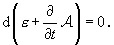
entering any closed surface must also leave it. Inserting (3.1) into the second Maxwell's equation (2.114b) yields
| (3.2) | |
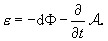
Since the exterior derivative of the one-form inside the brackets vanishes, we may express this one-form due to Poincar 's lemma (A.61) as the exterior derivative of the scalar potential ? and obtain
| (3.3) | |
The negative sign of ? has been chosen due to the physical convention in definition of potentials. Whereas in electrostatics the electric field may...