Electromagnetics, Microwave Circuit, and Antenna Design for Communications Engineering, Second Edition

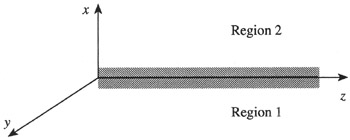
We consider the propagation of an electromagnetic wave along a plane conducting surface. To simplify our considerations we assume the conducting plane to be infinitely extended in the yz-plane. According to Figure 6.1 the space is subdivided into two half-spaces 1 and 2 by a plane surface at x = 0. The half-spaces 1 and 2 each are filled with homogeneous and isotropic media. This problem is encountered when the propagation of electromagnetic waves along the Earth's surface or the propagation of electromagnetic waves along metallic surfaces is considered. Assuming region 1 to be filled with an ideal conductor a tem wave with electric field perpendicular to the plane z = 0 and magnetic field parallel to this plane fulfills the boundary conditions. In the conductor surface the tangential magnetic field induces a surface current, shielding region 1 from the magnetic field. The tangential magnetic field is directed perpendicular to the direction of wave propagation, whereas the surface current is flowing in the direction of wave propagation.
If, however the region 1 is filled with a conductor of finite conductivity, the electromagnetic field and the shielding current are penetrating into the conductor. Due to the finite conductivity, the current flowing in the direction of propagation gives rise to a longitudinal electric field component. The field in both regions 1 and 2 is transverse magnetic. Due to the conductor losses, the electromagnetic wave is attenuated in the direction of propagation. In transverse...