Electromagnetics, Microwave Circuit, and Antenna Design for Communications Engineering, Second Edition

Appendix A: Vectors and Differential Forms

A.1 Vectors

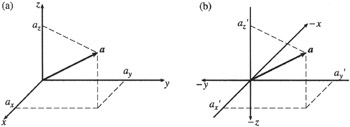
This section gives a compact summary of the vector algebra for the linear three-dimensional vector space. For a more detailed treatment see for example [1, 2]. A vector is a variable quantity that has both magnitude and direction and can be resolved into components, such as force, electric, and magnetic field. In the Cartesian coordinate system ( x, y, z) a vector a is represented by its Cartesian coordinates ( a x, a y, a z). The vector may be visualized by an arrow starting fom the origin and terminating at the point ( a x, a y, a z), as depicted in Figure A.1(a). However, we could start from any point in our Cartesian reference frame. The origin only is chosen for simplicity.


Figure A.1: Cartesian components of a vector (a) in a right-handed coordinate system, and (b) in a left-handed coordinate system.

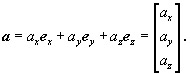
Let e x be a vector of unit magnitude pointing in the positive x -direction and e y and e z vectors of unit magnitude pointing in the positive y- and z-directions, respectively. By vector addition we obtain

(A.1)

The vectors e x, e y, and e z form a basis of our three-dimensional linear vector space. Figure A.1(a) shows the vector a in a right-handed Cartesian coordinate system ( x, y, z), whereas in Figure A.1(b) the...

UNLIMITED FREE
ACCESS
TO THE WORLD'S BEST IDEAS

SUBMIT
Already a GlobalSpec user? Log in.

This is embarrasing...

An error occurred while processing the form. Please try again in a few minutes.

Customize Your GlobalSpec Experience

Category: Robots
Finish!
Privacy Policy

This is embarrasing...

An error occurred while processing the form. Please try again in a few minutes.