Electromagnetics, Microwave Circuit, and Antenna Design for Communications Engineering, Second Edition

Periodic electromagnetic structures exhibit numerous applications as frequency-selective structures and slow-wave structures [1 4].
With the space-dependent real permittivity ?( x) and the space-dependent real permeability ?( x) for source-free regions Maxwell's equations (2.124a) and (2.124b) become
| (11.1a) | |
| (11.1b) | |
Eliminating either ?( x) or
yields the second-order equations for an inhomogeneous isotropic medium
| (11.2a) | |
| (11.2b) | |
Either one of the above equations is self-contained. We can derive the solution for the complete electromagnetic field by solving just one of them. If only ?( x) depends on space and ? is uniform we obtain from (11.2a)
| (11.3) | |
Consider a rectangular waveguide filled with a dielectric having a permittivity varying periodically in z-direction as shown in Figure 11.1. For the electric field form ?( x) of the transverse electric TE mn mode we make the ansatz
| (11.4) | |
where
is a complex voltage amplitude,
is the electric structure form introduced in (7.198a), and
describes the longitudinal variation of the field. To solve (11.3) we first consider the first term on its left-hand side,
| (11.5) | |
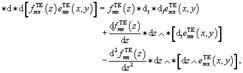
On the right-hand side of this equation the second term vanishes and in the third term the two-fold application of the operator * dz ? (.) means a rotation of e( x, y) by 180 . Therefore we obtain
| (11.6) | |
Due to (7.216a) the structure function of the TE mn