Electromagnetics, Microwave Circuit, and Antenna Design for Communications Engineering, Second Edition

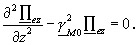
Transverse electromagnetic or TEM waves exhibit no field components in the direction of propagation [2 5]. Choosing the z-direction as the direction of propagation, we obtain E z = 0 and H z = 0. Therefore we can derive the transverse electromagnetic wave from (7.8a) as well from (7.8b). We are choosing the formulation (7.8a). In this case the Helmholtz equation (7.9a) is valid and the field components in the Cartesian coordinate system are given by (7.13a) (7.18a). With E z = 0 we obtain from (7.15a)
| (7.19) | |
This equation is satisfied by
| (7.20) | |
For lossless lines we obtain ? M 0 = j ? M 0. Due to (7.10) the phase velocity of the TEM wave is equal to the phase velocity of the plane electromagnetic wave. In the following we assume ideal conductors in lossless media. From (7.9a) and (7.19), we obtain
| (7.21) | |
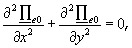
which holds for
( x, y) as well as
( x, y). This equation is the two-dimensional Laplace equation known from electrostatics. Due to (7.13a), (7.14a), (7.16a), and (7.17a) the two-dimensional Laplace equation must also be satisfied by the components E x, E y, H x, and H y. The transverse field distribution therefore corresponds to the field distribution of the static two-dimensional problem. Furthermore, from the validity of the two-dimensional Laplace equation for the transverse field components it follows that in a waveguide bounded...